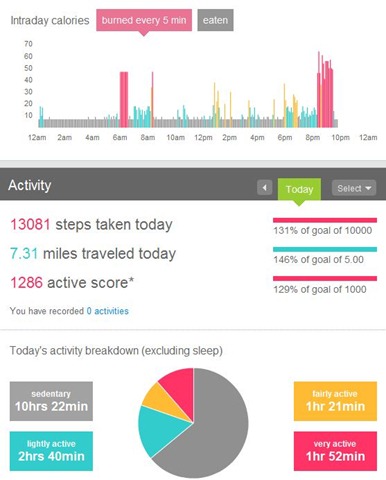
Not a bad day today. Got up at the crack of dawn, did 35m in the pool. Then sat in the car for 90 minutes and hit work. Work is mostly represented by the gray in pie chart below. Desk bound. However, as I continue to build on my routine, I will be sure to add more intraday walking – it will be good for me and it will be good for the team. I ended the day with about an hour of cardio (got a little trampoline today) while watching an episode of MI-5 (s5.e7). That worked pretty well – much better than an elliptical. Granted, this is new to fitness type exercise and will need to grow, but it was smashing tonight.
I picked up a flyer (possibly from the cafe at work) awhile ago that is mostly a photo of a cow in a field. In the foreground is a guy eating a salad. The main caption is “We’ve got to stop MEATing like this.” It is about being a flexitarian.
Semi-vegetarianism is a term used to describe diets that are not vegetarian, but include less meat than typical diets. The term has no precise or widely accepted definition, but is generally defined as the avoidance of red meat and/or generally following a vegetarian diet, but eating meat occasionally. The term is sometimes used interchangeably with "flexitarianism".
This definition is not quite right for me. I am starting by skipping meat once a week. Starting this week. Starting today. This will help me avoid some of the issues with eating too much meat as well as help grow my knowledge of nutrition like the need to find decent protein replacements. Week one … check!
Questions
According to the 2005 Dietary Guidelines for Americans:
- Don’t exceed 2,300 mg of sodium a day if you’re a healthy adult.
- Don’t exceed 1,500 mg of sodium a day if you have high blood pressure, kidney disease or diabetes; you are black; or you’re middle-aged or older.
Sodium-free or salt-free. Each serving in this product contains less than 5 mg of sodium.
Very low sodium. Each serving contains 35 mg of sodium or less.
Low sodium. Each serving contains 140 mg of sodium or less.
Reduced or less sodium. Product contains at least 25% less than the regular version.
Lite or light in sodium. Product reduced by at least 50% from the regular version.
Unsalted or no salt added. No salt is added during processing of a food that normally contains salt. However, some foods with these labels may still be high in sodium.
Interesting Website that Merit Investigation
 17 Stones